

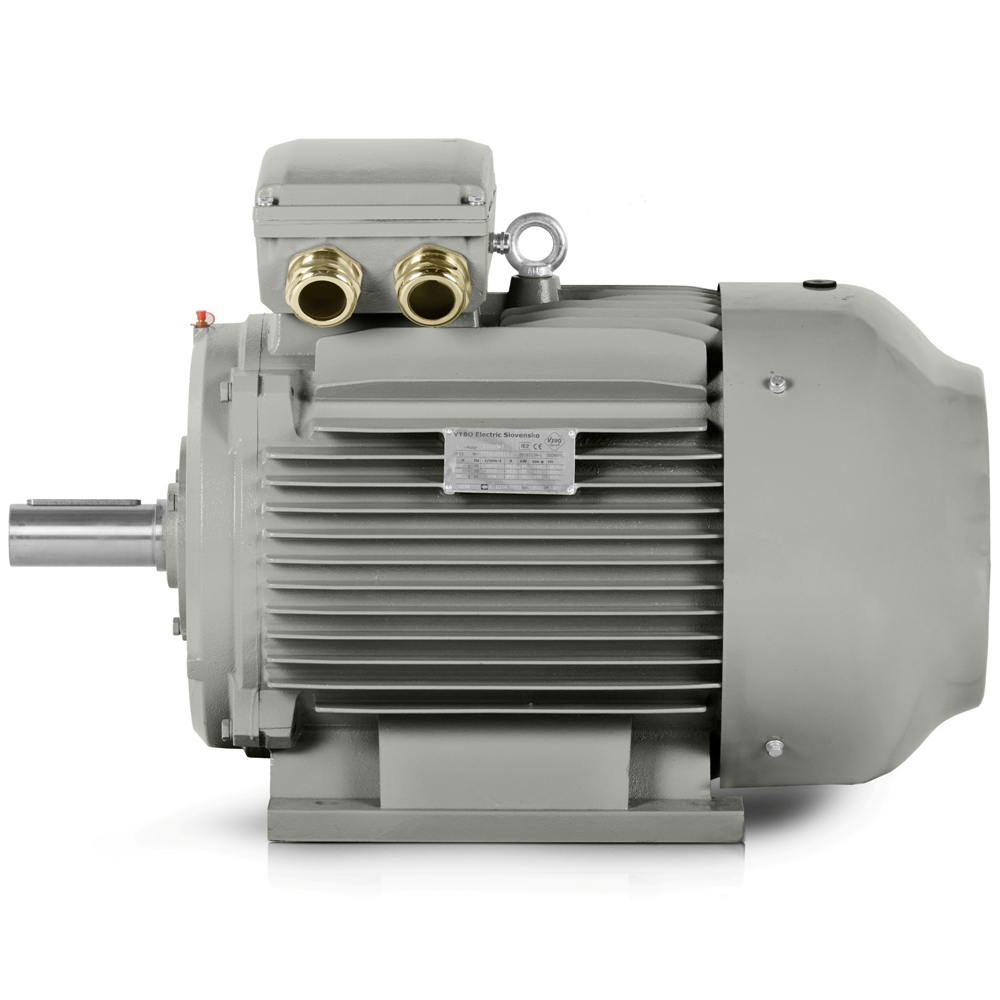
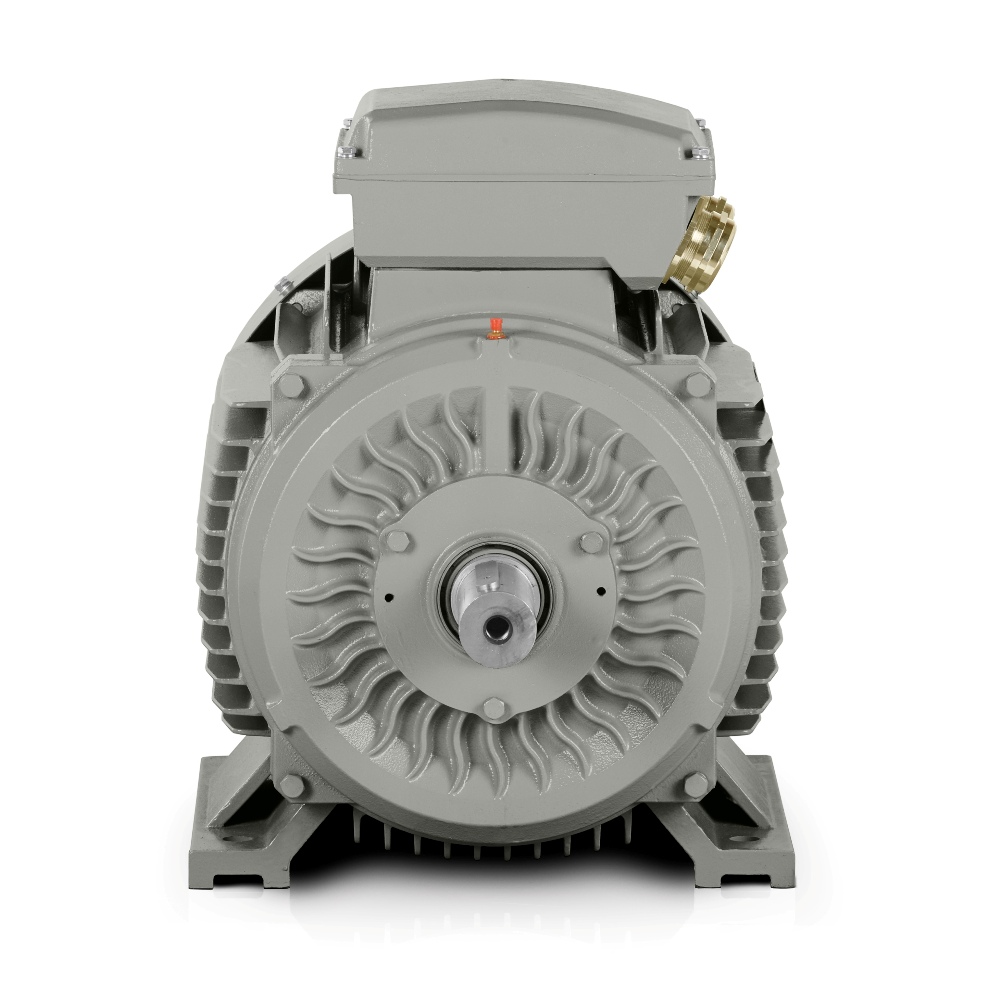
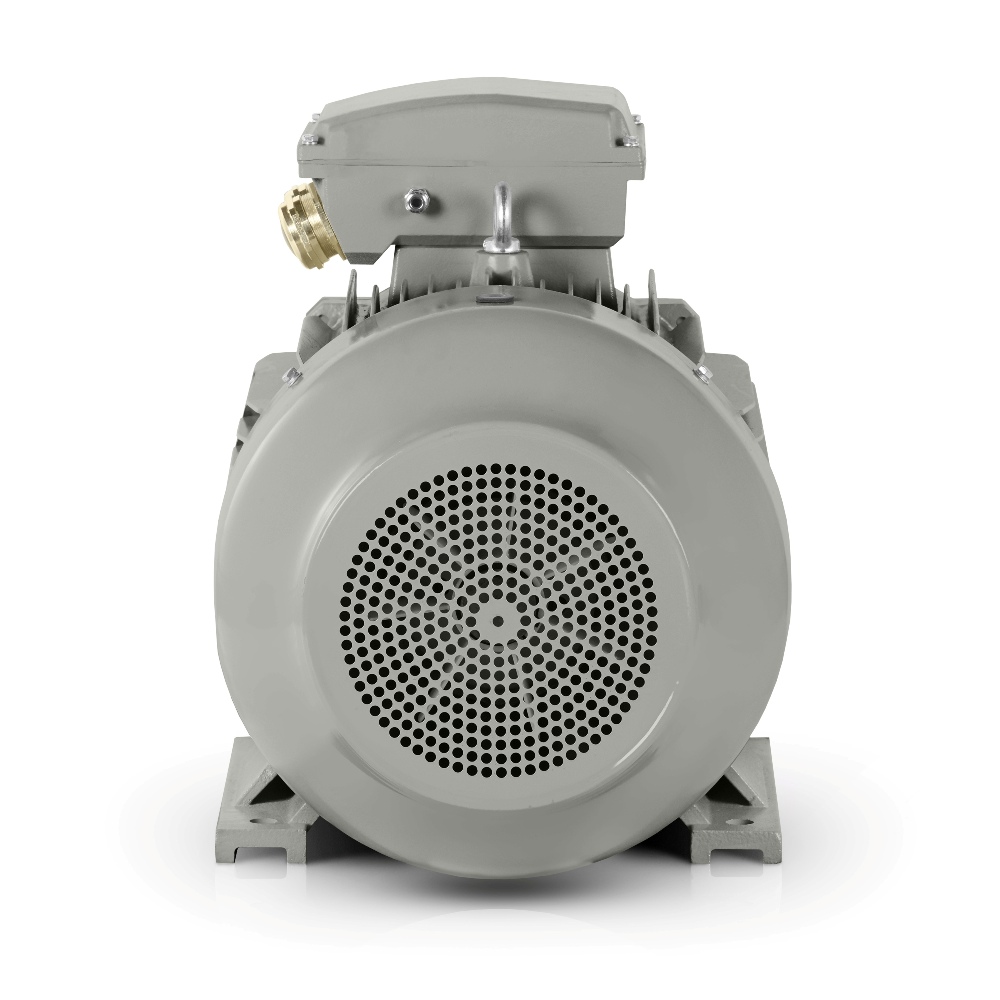
Three-phase electric motor: 3LC-225M-4, 45 kW
| Basic technical data | |
| Motor type | 3LC-225M-4 |
| Rated power (kW) | 45 |
| Frame size (mm) | 225 |
| Number of poles | 4 |
| Rated speed (rpm) | 1485 |
| Frequency (Hz) | 50 |
| Electrical parameters | |
| Rated voltage (V) | 400/690 |
| Connection | △/Y |
| Rated current 400 V (A) | 80,2 |
| Rated current 690 V (A) | 46,49 |
| Efficiency at 100% load (%) | 94,2 |
| Efficiency class | IE3 |
| Power factor at 100% load | 0,86 |
| Starting and torque characteristics | |
| Locked-rotor torque ratio (LRT/RLT) | 2 |
| Breakdown torque ratio (BDT/RLT) | 2,3 |
| Locked-rotor current ratio (LRA/RLA) | 7,4 |
| Rotor moment of inertia (kg·m²) | 0,6118 |
| Applicable standards | |
| Specification | IEC60034-1 |
| Testing | IEC60034-2 |
| Noise | IEC60034-9 |
| Vibration | IEC60034-14 |
| Construction and operating data | |
| Mounting arrangement | IM B3, B5, B35, V1 |
| Duty type | S1 (S2, S3, S4 – S9 optional) |
| Load type | Parabolic or linear curve |
| Degree of protection | IP55 |
| Insulation class | F |
| Temperature rise class | B |
| Cooling method | IC411 |
| Starting method | DOL, VFD, soft starter |
| Direction of rotation | Both |
| Vibration (mm/s) | 2.8 |
| Cable glands | 2-M50X1.5 |
| Operating conditions | |
| Ambient temperature range | -20 to +40°C (-30, +50, +60 optionally) |
| Maximum installation altitude | up to 1000m |
| Packaging and dimensions | |
| Packaging dimensions (mm) | 1012*542*596 |
| Package weight (kg) | 358 |
| Bearings and lubrication | |
| DE/NDE bearings | 6313-C3/6313-C3 |
| Lubricant | Lithium-based grease No. 2 (temperature class) |
| Accessories | |
| 3 x PTC thermistor | |
The four-pole electric motor 3LC-225M-4 with a power output of 45 kW and a rated speed of 1485 rpm delivers efficiency and value for equipment drives where stable operation, practical service support and long-term operational reliability are priorities.
Four-pole electric motor for drives with a steady operating regime
A rated voltage of 400/690 V enables straightforward integration into common industrial power systems and smaller technological units. An asynchronous electric motor in this class performs well wherever smooth starting, consistent operation and predictable response to load are required.
In practice, it is suitable for the following applications:
- pumping units for cooling-water circulation,
- belt-driven ventilation units,
- compressor stations for workshop air-distribution systems,
- mixing equipment for bulk-material processing,
- conveyor lines in packaging operations,
- cutters and chippers in wood-processing production,
- extruders with constant load,
- smaller pressing and forming units.
Robust cast-iron frame maintains geometry under continuous load
A robust cast-iron frame helps maintain precise mechanical support even in operations where the motor is exposed to vibration, frequent starts and long duty cycles. Reinforced cast-iron bearing shields and reinforced cast-iron feet increase mounting rigidity, which is important when installing the motor into machine frames and compact drive assemblies.
This solution is particularly appreciated by OEM manufacturers that need to integrate the motor into their own designs without additional modifications to load-bearing components. A noise level of 78 dB(A) also supports use in operations where workplace acoustic load is monitored.
Energy efficiency for long operating cycles
IE3 efficiency class supports energy-efficient operation under normal load and reduces losses in applications where the motor runs in multi-shift operation. In this type of use, the IE3 electric motor delivers a better relationship between useful output and energy consumption.
A rated current of 80.2 A at △ 400V and 46.49 A at Y 690V gives designers clear data for selecting switching equipment, protective devices and switchgear sizing. A power factor of 0.86 helps when designing drives in assemblies where the electrical balance of the entire line is also monitored.
Starting characteristics and inertia for stable machine integration
A starting torque ratio of 2 and breakdown torque ratio of 2.3 support use in applications that require smooth acceleration without unnecessary stress on transmissions or couplings. A starting current ratio of 7.4 is important when designing starting conditions and network protection.
Rotor inertia of 0.612 kg/m² supports predictable behaviour during acceleration and changes in load. The DE bearing 6313-C3 and NDE bearing 6313-C3 increase mounting reliability in assemblies where long service intervals are expected. Cable glands 2-M50X1.5 simplify installation in space-constrained cabinets and enclosures.
Ready for OEM machines and smaller technological units
Package dimensions of 1012*542*596 mm and a packaged weight of 358 kg are important for logistics and receiving into production. The 225 mm frame size provides a sufficient basis for installation in machines that require a more robust frame without excessive space demands.
When selecting a motor for light and medium industry, it is also valuable that the unit is ready for integration into serial assemblies where repeatable installation and service availability are important. Drawing on more than 15 years of experience in drive technology, applications of this type favour a solution compatible with standard maintenance and common replacement parts.
If your project needs a durable drive with a sensible energy balance, order the 3LC-225M-4 in good time. Stock levels in this category can change quickly, so it is worth completing the purchase without delay.
Durable drive for continuous operation in workshops and production
An asynchronous electric motor of this design is suitable for equipment where stable performance without complex operation is expected. Combined with a robust cast-iron frame, it creates a solution that better withstands mechanical stress while remaining suitable for standard industrial integration.
When used in pumps, fans, conveyors, mixers, compressors, extruders, chippers and pressing units, this motor provides a solid basis for operations where reliable repeatability of performance is decisive. If required, the order can be arranged immediately to minimise delays in installation and commissioning of the technology.