
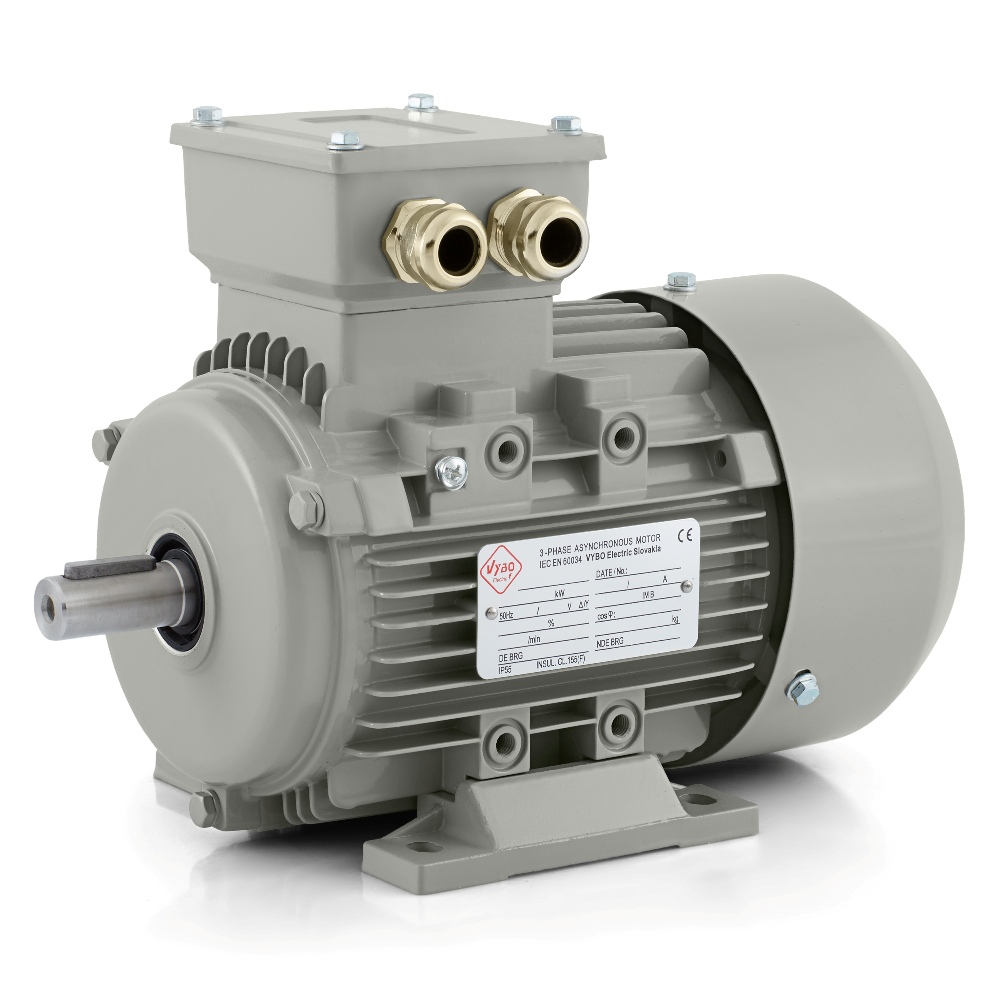


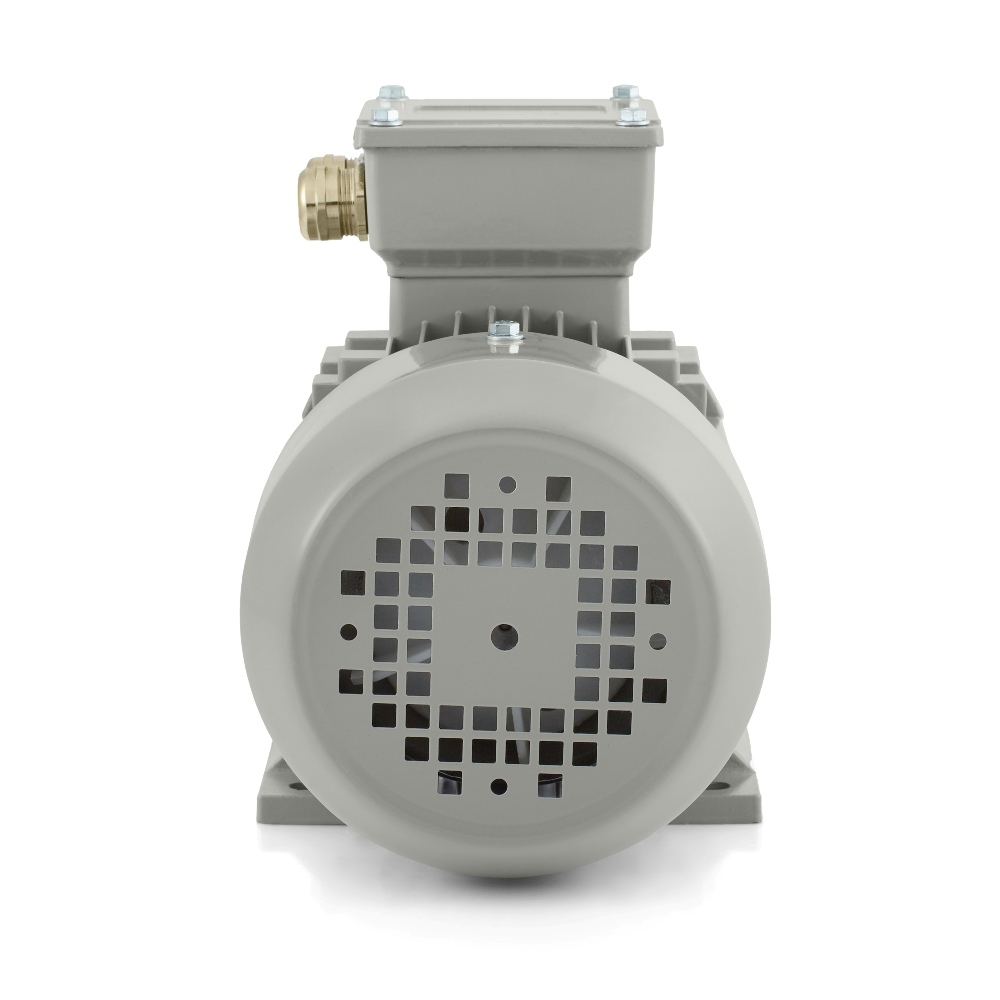
Three-phase electric motor: 1AL-71M1-6, 0,18 kW
| Basic technical data | |
| Motor type | 1AL-71M1-6 |
| Rated power (kW) | 0,18 |
| Frame size (mm) | 71 |
| Number of poles | 6 |
| Rated speed (rpm) | 870 |
| Frequency (Hz) | 50 |
| Electrical parameters | |
| Rated voltage (V) | 230/400 |
| Connection | △/Y |
| Rated current 230 V (A) | 1,22 |
| Rated current 400 V (A) | 0,7 |
| Efficiency at 100% load (%) | 56 |
| Power factor at 100% load | 0,66 |
| Starting and torque characteristics | |
| Locked-rotor torque ratio (LRT/RLT) | 2 |
| Breakdown torque ratio (BDT/RLT) | 1,9 |
| Locked-rotor current ratio (LRA/RLA) | 4 |
| Rotor moment of inertia (kg·m²) | 0,0011 |
| Applicable standards | |
| Specification | IEC60034-1 |
| Testing | IEC60034-2 |
| Noise | IEC60034-9 |
| Vibration | IEC60034-14 |
| Construction and operating data | |
| Mounting arrangement | B3, B5, B14, B14B, B34, B35 |
| Duty type | S1 (S2, S3, S4 – S9 optional) |
| Load type | Parabolic or linear curve |
| Degree of protection | IP55 |
| Insulation class | F |
| Temperature rise class | B |
| Cooling method | IC411 |
| Starting method | DOL, VFD, soft starter |
| Direction of rotation | Both |
| Vibration (mm/s) | 2.8 |
| Cable glands | 2-M20X1.5 |
| Operating conditions | |
| Ambient temperature range | +65°C |
| Maximum installation altitude | up to 1000m |
| Packaging and dimensions | |
| Packaging dimensions (mm) | 260*170*215 |
| Package weight (kg) | 6 |
| Bearings and lubrication | |
| DE/NDE bearings | 6202-2Z/6202-2Z |
| Lubricant | Lithium-based grease No. 2 (temperature class) |
VYBO Electric 1AL-71M1-6 motor for stable 6-pole operation
Electric motor 1AL-71M1-6 with an output of 0.18 kW operates at a frequency of 50 Hz and a rated speed of 870 rpm. The six-pole design is suitable where a steadier running performance and more precise motion control are required, without an unnecessarily fast drive response. The rated voltage of 230/400 V in the △/Y connection makes it easier to integrate into standard three-phase systems. The rated current of 1.22 A at 230 V and 0.7 A at 400 V helps with the design of power supply, protection and control selection in compact technologies. In practice, this is a motor that performs well wherever the drive is expected to run regularly, cleanly and with modest space requirements.
Starting, control and operating mode
During start-up, it offers a starting torque ratio of 2 and a pull-out torque ratio of 1.9. This means a confident start even in situations where the equipment needs to overcome initial resistance without jerky behaviour. The starting current ratio of 4 also helps to estimate the load on the mains at start-up. The motor is suitable for direct DOL starting, for frequency-inverter control and for operation with a soft starter, so it can be used in both simple and regulated drives. Thanks to this, it is suitable for example for fans in local extraction systems, conveyor belts, dosing units, mixers with a lighter working resistance, sorting mechanisms, packaging equipment, simple pumping systems, air-handling assemblies, feeds in workshop machines and cleaning technologies. The operating modes S1, S2, S3 and S4-S9 provide scope for continuous operation as well as interrupted cycles according to the nature of the line.
What speed and inertia mean in real operation
The rated speed of 870 rpm brings a calmer working rhythm, which is often desired where the equipment should not run abruptly, but smoothly and repeatedly. The rotor inertia of 0.0011 kg·m² supports a brisk response to start-up and changes in control without unnecessary sluggishness. With a linear or parabolic load curve, the motor behaves predictably and integrates well into drives where stable running throughout the entire shift is important. Rotation in both directions is possible, which expands the application options for reversing tasks or for designs where the direction is determined only during equipment assembly.
Protection, cooling and durability
For industrial operation it is important that the motor operates with IP55 protection. This level of protection helps in applications in environments where dust, normal operating moisture or dispersed contaminants are present. IC411 cooling supports a stable thermal regime during normal operation, and F insulation class together with B temperature rise creates a suitable reserve for long-term use. The motor is intended for an ambient temperature of up to +65 °C and an altitude of up to 1000 m. The vibration grade of class A and a vibration value of 2.8 mm/s help to maintain smooth mechanical running, which is important for more precise machine mounting and for protecting the connected parts of the technology. In the 1AL OPTIMAL platform, VYBO Electric combines compact dimensions with proven quality and a design developed for efficient cooling.
Mechanical design and service reliability
The frame size of 71 mm makes it easier to use in machines where every centimetre of mounting space matters. The design includes 2-M20X1.5 cable entries, which simplify clean power connection. Balancing with a half key helps to ensure a secure connection to the the machine’s mechanical system. On both the DE and NDE sides, 6202-2Z bearings lubricated with No. 2 lithium-based grease are used, which supports stable operation under normal industrial load. The packaged weight of 6 kg and packaging dimensions of 260 × 170 × 215 mm make handling easier during storage, transport and assembly preparation. The electric motor is suitable for use in standalone machines as well as in mass-produced equipment, where reliable mounting and easy integration into production are appreciated.
Practical importance for technology
Electric motor 1AL-71M1-6 is a solution for operations that require a compact three-phase drive with 6 poles, IP55 protection and flexibility in control. It fits well into production units, building services equipment and industrial assemblies, where smooth running, bidirectional operation and easy commissioning are important. In the 1AL OPTIMAL series, VYBO Electric focuses on excellent value for money, fast commissioning and wide application in industry. The result is a motor that provides a reliable basis for the everyday operation of technology without unnecessary complexity.
