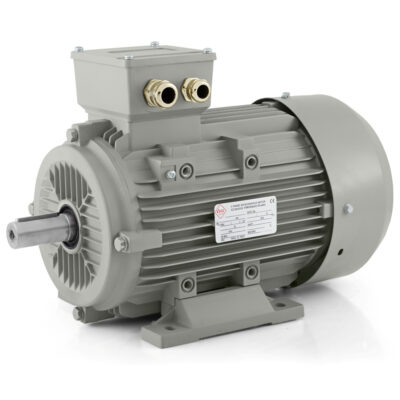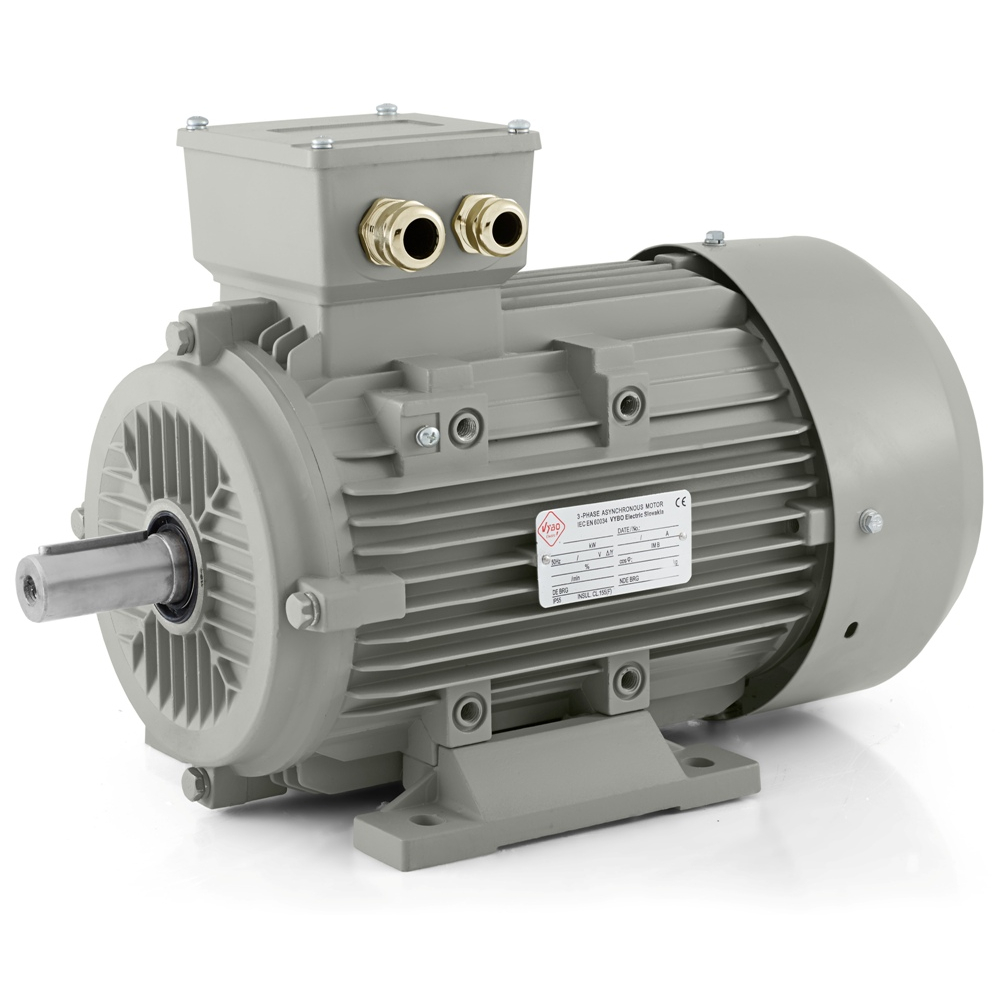
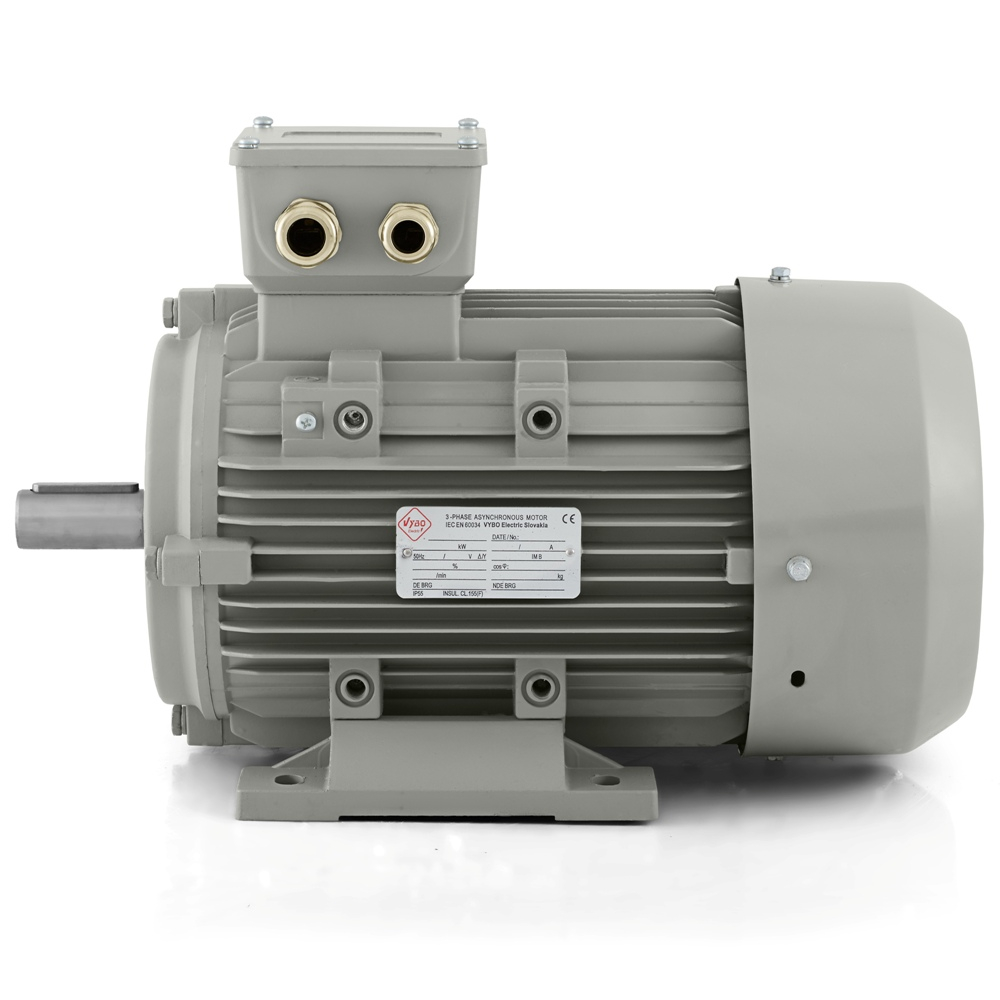

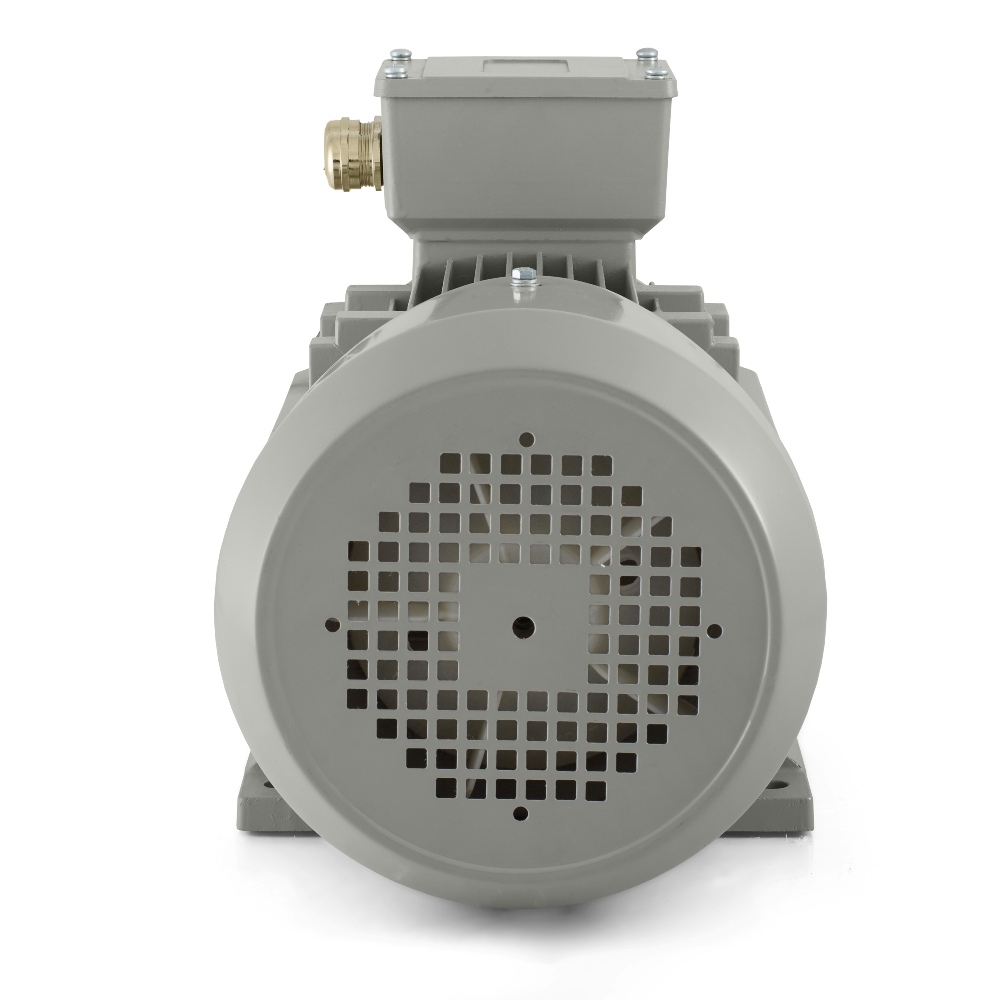
Three-phase electric motor: 1AL-112M-8, 1,5 kW
| Basic technical data | |
| Motor type | 1AL-112M-8 |
| Rated power (kW) | 1,5 |
| Frame size (mm) | 112 |
| Number of poles | 8 |
| Rated speed (rpm) | 690 |
| Frequency (Hz) | 50 |
| Electrical parameters | |
| Rated voltage (V) | 230/400 |
| Connection | △/Y |
| Rated current 230 V (A) | 7,34 |
| Rated current 400 V (A) | 4,22 |
| Efficiency at 100% load (%) | 74 |
| Power factor at 100% load | 0,7 |
| Starting and torque characteristics | |
| Locked-rotor torque ratio (LRT/RLT) | 2,0 |
| Breakdown torque ratio (BDT/RLT) | 1,8 |
| Locked-rotor current ratio (LRA/RLA) | 5,0 |
| Rotor moment of inertia (kg·m²) | 0,0245 |
| Applicable standards | |
| Specification | IEC60034-1 |
| Testing | IEC60034-2 |
| Noise | IEC60034-9 |
| Vibration | IEC60034-14 |
| Construction and operating data | |
| Mounting arrangement | B3, B5, B14, B14B, B34, B35 |
| Duty type | S1 (S2, S3, S4 – S9 optional) |
| Load type | Parabolic or linear curve |
| Degree of protection | IP55 |
| Insulation class | F |
| Temperature rise class | B |
| Cooling method | IC411 |
| Starting method | DOL, VFD, soft starter |
| Direction of rotation | Both |
| Vibration (mm/s) | 2.8 |
| Cable glands | 2-M32X1.5 |
| Operating conditions | |
| Ambient temperature range | +65°C |
| Maximum installation altitude | up to 1000m |
| Packaging and dimensions | |
| Packaging dimensions (mm) | 420*245*310 |
| Package weight (kg) | 28 |
| Bearings and lubrication | |
| DE/NDE bearings | 6306-2Z/6306-2Z |
| Lubricant | Lithium-based grease No. 2 (temperature class) |
Reliable 8-pole drive for a steady working rhythm
When a drive for a slower working pace is added to a technology, what matters is not only the power rating, but also how the motor behaves after connection, during start-up and after hours of continuous operation. Electric motor 1AL-112M-8 with a power output of 1.5 kW, nominal speed of 690 rpm and frame size of 112 mm is designed precisely for this type of task. It is suitable for technologies where the material is not conveyed quickly, but regularly and with good control over movement. In practice, this may include feeders, belt conveyors, mixing vessels, circulation pumps, suction branches, drying modules, sorting tables, filling units, slow-speed winding or rotary working units. In these devices, maintaining a steady rhythm is usually more important than achieving high speed, and that is exactly where the 8-pole design has its operational significance.
What is essential about this model in everyday operation
- 690 rpm helps maintain smooth transmission of movement in feeding, mixing and medium circulation.
- 230/400 V and Delta/Star connection simplify electrical integration into a standard industrial network.
- Starting torque ratio of 2.0 gives the motor confidence at start-up, even when the working cycle is repeated regularly.
- IP55 and IC411 support reliable operation in environments with dust, moisture and normal industrial contamination.
- 6306-2Z bearings, a vibration velocity of 2.8 mm/s and balancing with a half key help keep the mechanical system calm even during longer service.
Electrical behaviour and start-up without a harsh start
The motor is designed for a frequency of 50 Hz, and the rated current is 7.34 A at 230 V and 4.22 A at 400 V. These values provide a clear basis for the selection of protective and switching devices in standard industrial operation. From the point of view of start-up, it is important that the motor supports DOL, control by frequency inverter and use with a soft starter. In a simple device it can therefore be connected directly, while in more sensitive mechanics the start can be softened, and in a technology that needs its working pace adjusted, regulation is also available. This has practical importance, for example, in dosing bulk materials, in smooth filling, in mixing with regular changes in resistance or in conveyor branches where a calm start without unnecessary shocks is required.
The ratio of breakaway torque of 1.8 to rated torque helps to cope with normal load changes, and the starting current ratio of 5.0 is important for the correct setting of the electrical start. The motor is designed for a linear or parabolic load curve, so it is well suited to applications with a gradual increase in resistance as well as to devices with a regular working range. The service factor of 1.0 and the operating modes S1, S2, S3 and S4-S9 allow this model to be used for continuous operation as well as repeated cycles throughout the shift. In this respect, the 1AL OPTIMAL series is designed as a professional VYBO Electric platform for quick and reliable commissioning.
Construction, protection and practical details during installation
When mechanically mounted, it is important that the motor maintains stability even during long-term service. This is matched by the 112 mm frame, bearings on both sides and the rotor inertia of 0.0245 kg·m², which contributes to a balanced response at start-up and when the operating state changes. The motor can rotate in either direction, so integration into different machine assemblies does not require unnecessary compromises in design. The design includes 2-M32X1.5 cable glands, which makes industrial connection easier without improvisation during installation.
Protection during everyday use is supported by IP55 enclosure. The motor is therefore ready for environments where work is carried out with dust, more humid air or industrial contaminants. IC411 cooling removes heat under standard load, and the combination of insulation class F with temperature rise B creates a reliable basis for regular operation. Use is intended for ambient temperatures up to +65 °C and altitudes up to 1000 m. Noise level of 61 dB(A) supports smooth operation in technologies working in halls with multiple machines or closer to the operator. When handling, the packaging dimensions of 420 × 245 × 310 mm and the packaged weight of 28 kg are helpful. The bearing system uses No. 2 lithium-based grease.
Electric motor 1AL-112M-8 is ready for operations where steady motion, reliable starting and straightforward integration into the application are required. Once installed, it works exactly where production needs calm operation, stable transmission of power and a reliable industrial foundation.