
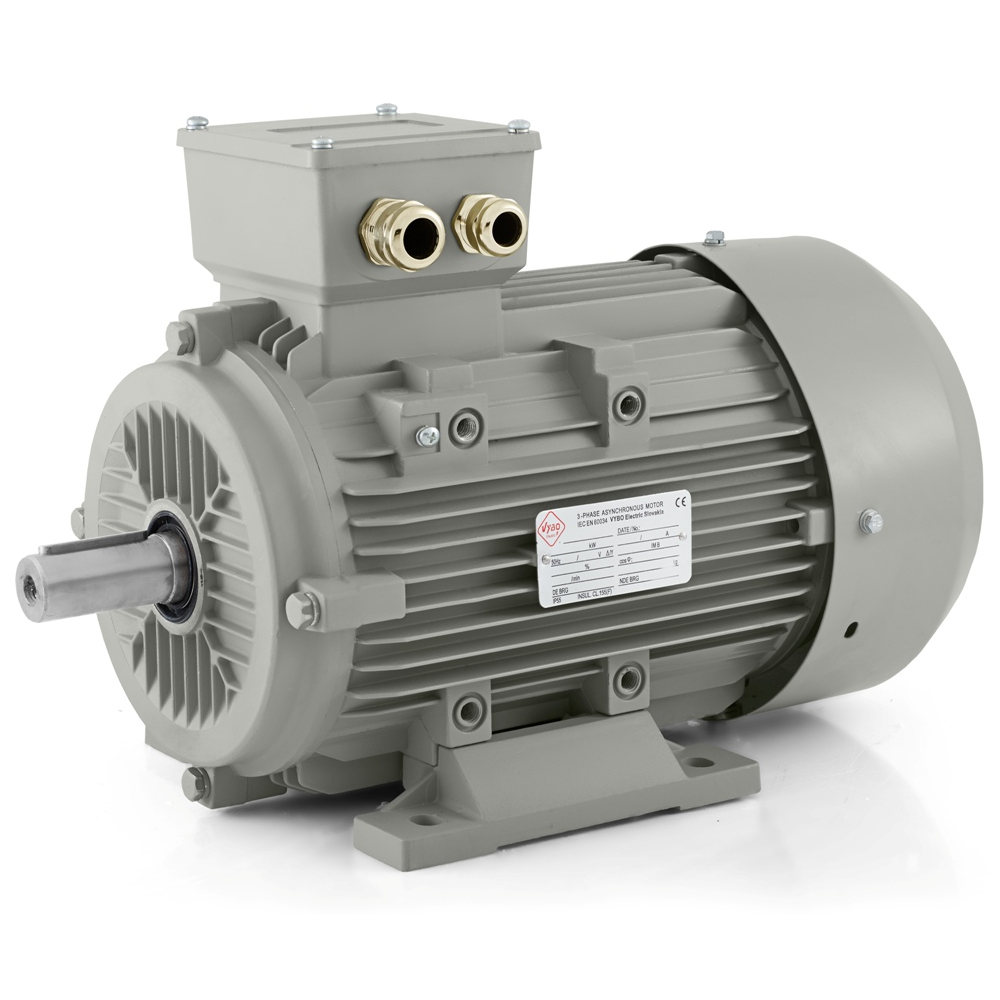
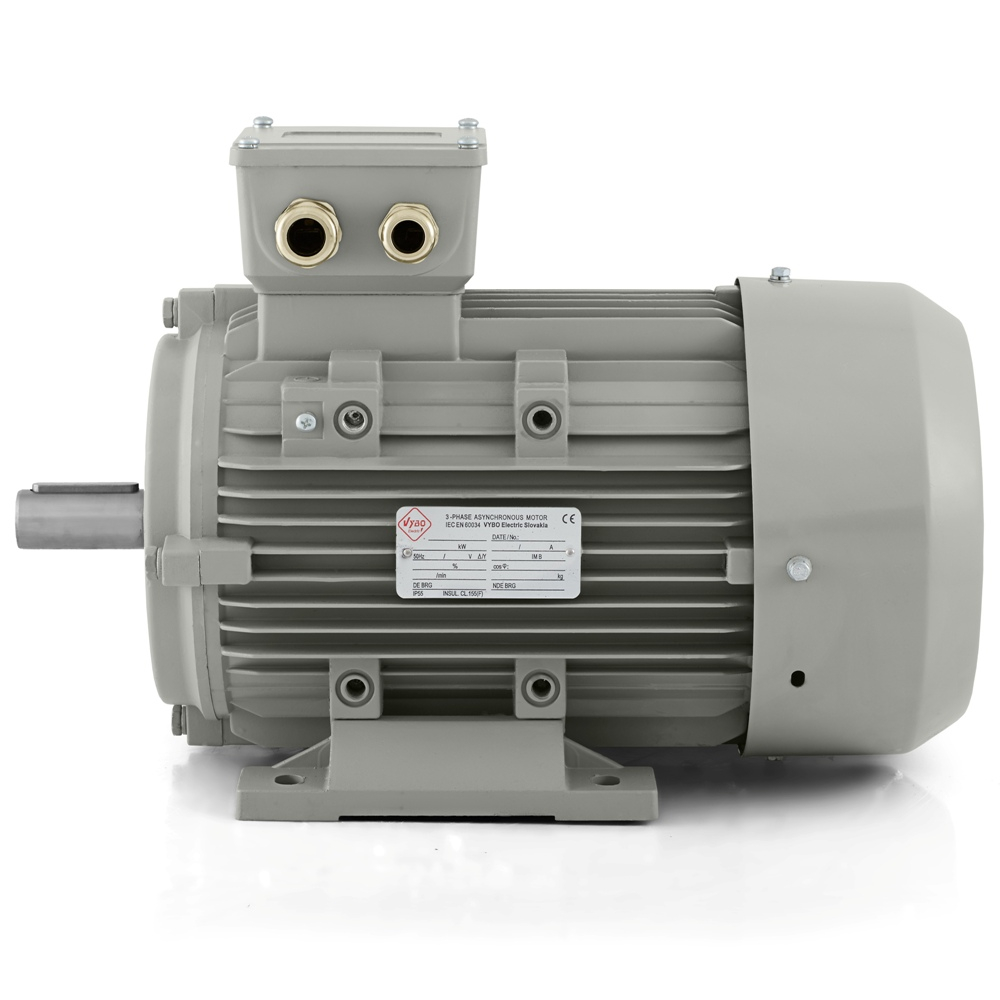
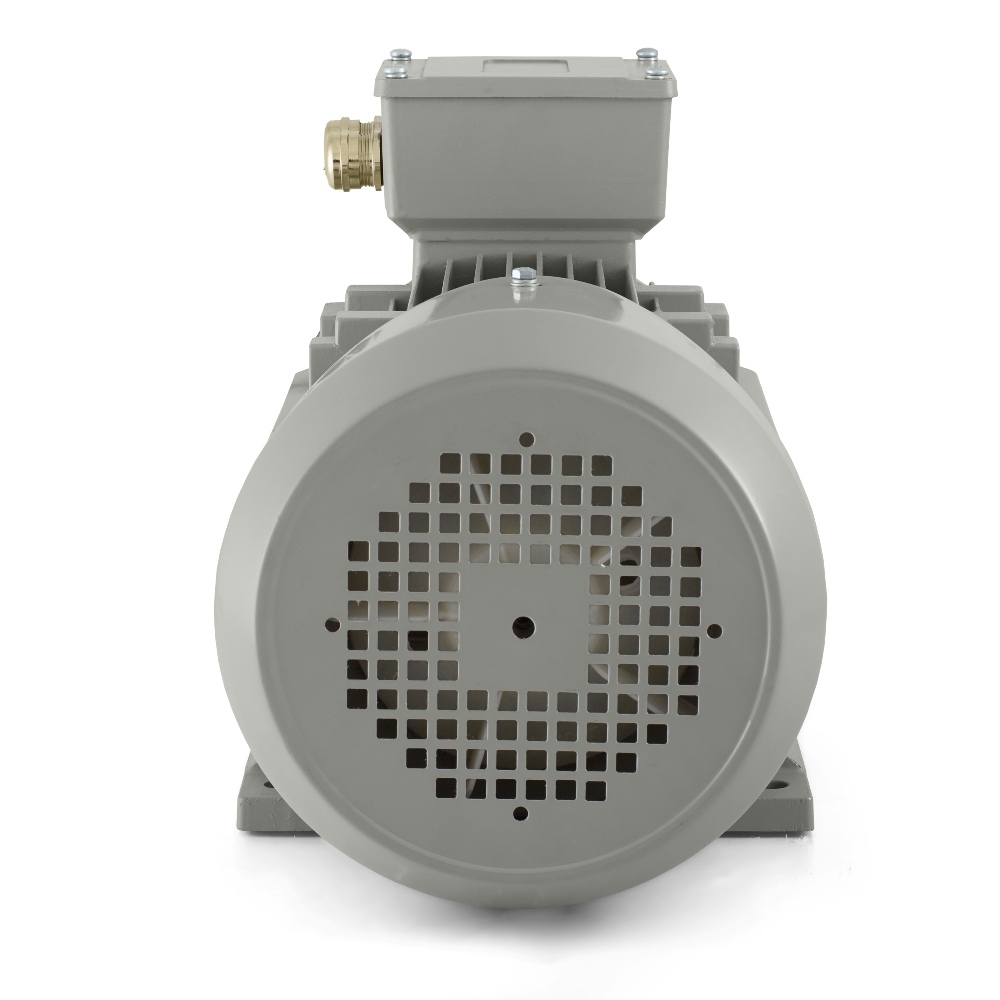

Three-phase electric motor: 1AL-160M1-8, 4 kW
| Basic technical data | |
| Motor type | 1AL-160M1-8 |
| Rated power (kW) | 4 |
| Frame size (mm) | 160 |
| Number of poles | 8 |
| Rated speed (rpm) | 720 |
| Frequency (Hz) | 50 |
| Electrical parameters | |
| Rated voltage (V) | 400/690 |
| Connection | △/Y |
| Rated current 380 V (A) | 10,3 |
| Rated current 400 V (A) | 9,78 |
| Rated current 415 V (A) | 9,37 |
| Rated current 690 V (A) | 5,67 |
| Efficiency at 100% load (%) | 81 |
| Efficiency class | No IE classified |
| Power factor at 100% load | 0,73 |
| Starting and torque characteristics | |
| Locked-rotor torque ratio (LRT/RLT) | 2,0 |
| Breakdown torque ratio (BDT/RLT) | 1,9 |
| Locked-rotor current ratio (LRA/RLA) | 6,0 |
| Rotor moment of inertia (kg·m²) | 0,0753 |
| Applicable standards | |
| Specification | IEC60034-1 |
| Testing | IEC60034-2 |
| Noise | IEC60034-9 |
| Vibration | IEC60034-14 |
| Construction and operating data | |
| Mounting arrangement | B3, B5, B14, B14B, B34, B35 |
| Duty type | S1 (S2, S3, S4 – S9 optional) |
| Load type | Parabolic or linear curve |
| Degree of protection | IP55 |
| Insulation class | F |
| Temperature rise class | B |
| Cooling method | IC411 |
| Starting method | DOL, VFD, soft starter |
| Direction of rotation | Both |
| Vibration (mm/s) | 2.8 |
| Cable glands | 2-M40X1.5 |
| Operating conditions | |
| Ambient temperature range | +65°C |
| Maximum installation altitude | up to 1000m |
| Packaging and dimensions | |
| Packaging dimensions (mm) | |
| Package weight (kg) | 71 |
| Bearings and lubrication | |
| DE/NDE bearings | 6309-2RZC3/6309-2RZC3 |
| Lubricant | Lithium-based grease No. 2 (temperature class) |
From installation to continuous operation, a calm 8-pole drive for a more demanding work rhythm
In larger slow-speed technologies, it is important that the new drive can be fitted into the machine without problems and, once started, works exactly as the process requires. Electric motor 1AL-160M1-8 with an output of 4 kW, rated speed of 720 rpm and supply of 400/690 V belongs among models designed for stable power transmission at a slower working pace. It is suitable wherever the technology does not rely on high speed, but on smooth operation during longer working intervals. Such application is typical for mixing tanks, screw conveyors, belt lines, circulation pumps, fan assemblies, extraction branches, drying modules, dosing systems, filling lines, and also for slow-speed rotary mechanisms in manufacturing and materials processing.
In an 8-pole design, the character of movement is particularly important. The speed of 720 rpm gives the motor a smoother operating behaviour, which is transferred well to the the machine’s mechanical system. In practice, this means more even material conveying, smoother mixing of tank contents, calmer starting of air-handling circuits, and more stable behaviour during liquid circulation. The output of 4 kW here represents not only a power level, but a real foundation for technologies that must operate for many hours without fluctuations and without the need for aggressive dynamics.
Mechanical fitting and confidence in power transmission
Frame size 160 mm predetermines this model for use in machines where the mechanical system already require a solid base and stable mounting. This frame is suitable for equipment with a more robust construction, for longer conveying sections, for larger mixing units, and for pumping and ventilation assemblies where the drive operates at a regular rhythm throughout the shift. 6309-2RZC3 bearings on the DE and NDE sides support reliable rotor mounting and contribute to mechanical confidence in long-term operation. A vibration velocity of 2.8 mm/s in class A help maintain smooth operation when connected with a pulley, coupling, or other transmission element.
An important detail is the balancing with half key, which meets the usual requirements of industrial installation. The motor can rotate in either direction, so the motor can be used in various types of technological assemblies without unnecessary adjustment of the mechanical system. The rotor inertia of 0.0753 kg·m² supports a smoother response during starting and when changing operating state, which is especially advantageous in equipment that moves between several process phases. The design includes 2-M40X1.5 cable entries, which make it easier to prepare the connection in line with industrial practice.
Electrical connection and integration into control systems
The motor is designed for a frequency of 50 Hz and Delta/Y connection. The rated current is 9.78 A at 400 V and 5.67 A at 690 V, which provides a clear basis for designing protection, switching, and protective elements in the control cabinet. In larger technological units, it is important that the electrical side remains clear and easy to integrate into the existing plant infrastructure. The motor is suitable for DOL, for operation with a frequency converter and a soft starter, so it can be used in both simpler and controlled applications. For some machines, direct starting is sufficient, while for others a gentler start or the ability to adapt the working pace to the specific process is more advantageous.
This approach is practical for dosing lines, transport paths with regular starting, mixing with changing resistance, and also for fans and pumps where operation is set according to the needs of the technology. This is also where the 1AL OPTIMAL platform stands out, designed as a professional VYBO Electric solution for broad industrial use, with emphasis on compatibility and easy integration into operation.
Working load and operating character
This model is designed for a parabolic or linear load curve, and therefore naturally suits tasks where the resistance increases smoothly or remains within a regular working range. In operation, this means a good foundation for fan and pumping applications, but also for mechanical processes in which the material is conveyed, metered, mixed, or rotated evenly. The starting current ratio of 6.0 helps with the design of the starting method and the choice of protection so that motor start-up is in line with the electrical part of the equipment. Eight poles and 4 kW of output together create a working profile that proves itself where the technology requires endurance and regularity rather than a quick rise to high speed.
Protection, cooling, and conditions in the hall
In normal production operation, dust, moisture, fluctuations in ambient temperature, and long working intervals must be taken into account. IP55 protection helps protect the motor in such an environment, and IC411 cooling supports heat dissipation under standard load. Insulation class F together with a temperature rise B creates a suitable basis for reliable operation in both continuous and intermittent service. The motor is prepared for S1, S2, S3 and S4-S9 duty modes, so it can operate in long continuous running as well as in repeated cycles. Use is intended for an ambient temperature of up to +65 °C and an altitude of up to 1000 m. The noise level of 68 dB(A) corresponds to the power category and, when fitted correctly, supports a smooth operation in an industrial hall.
Electric motor 1AL-160M1-8 is a solution for technologies that need robust mechanical construction, a clearly readable electrical connection, and a slow-speed output capable of operating reliably in everyday use. Once fitted into the machine, it delivers exactly what is expected from an 8-pole industrial drive: calm operation, stable energy transmission, and readiness for long-term service.