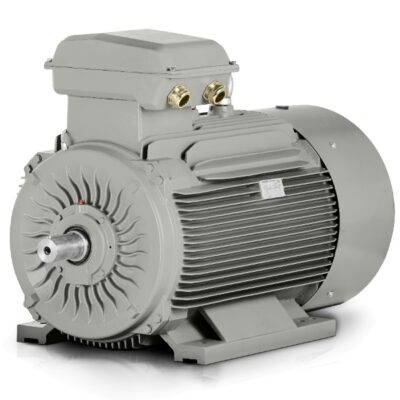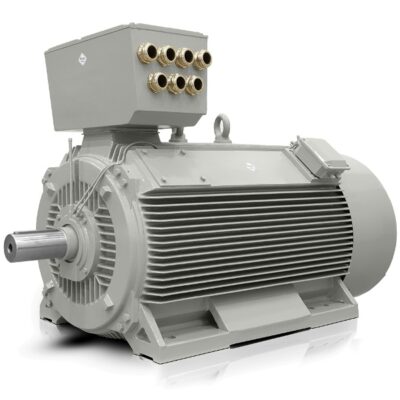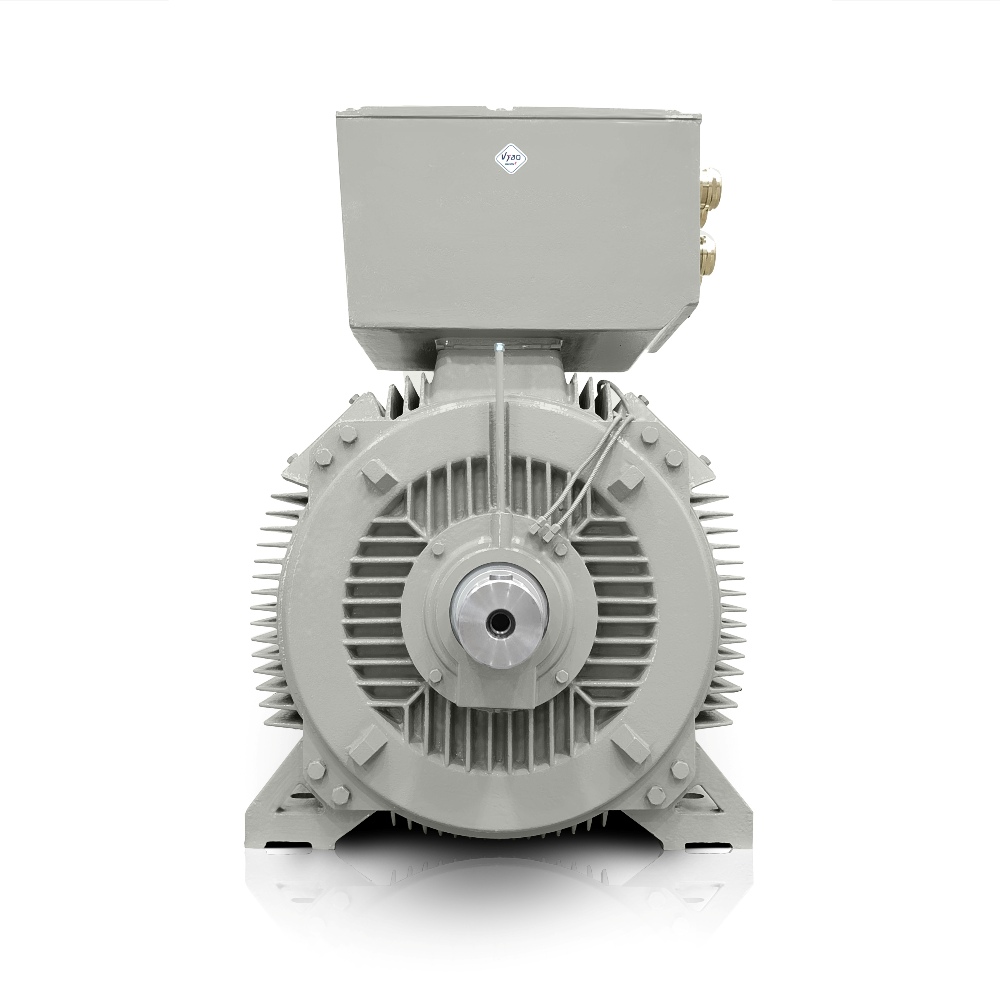
Three-phase electric motor: H17RL-450X2-8 560KW 400V/690V 50HZ
| Basic technical data | |
| Motor type | H17RL 450X2-8 |
| Rated power (kW) | 560 |
| Frame size (mm) | 450 |
| Number of poles | 8 |
| Rated speed (rpm) | 742 |
| Frequency (Hz) | 50 |
| Electrical parameters | |
| Rated voltage (V) | 400/690 |
| Connection | D/Y |
| Rated current 400 V (A) | 1045 |
| Rated current 690 V (A) | 606 |
| Efficiency at 100% load (%) | 95,8 |
| Power factor at 100% load | 0,81 |
| Starting and torque characteristics | |
| Rated torque (Nm) | 7208 |
| Locked-rotor torque ratio (LRT/RLT) in % | 120 |
| Breakdown torque ratio (BDT/RLT) in % | 200 |
| Locked-rotor current ratio (LRA/RLA) in % | 650 |
| External starting inertia (kg·m²) | 735 |
| Moment of inertia GD² (kg·m²) | 84 |
| Applicable standards | |
| Specification | IEC60034-1 |
| Testing | IEC60034-2 |
| Noise | IEC60034-9 |
| Vibration | IEC60034-14 |
| Construction and operating data | |
| Mounting arrangement | IM B3 (other designs on request) |
| Duty type | S1 |
| Load type | Parabolic or linear curve |
| Degree of protection | IP55 |
| Insulation class | F |
| Temperature rise class | B |
| Cooling method | IC411 |
| Starting method | DOL, VFD or soft starter |
| Direction of rotation | Both |
| Vibration (mm/s) | 2.8 |
| Rotor cage | copper rotor bars |
| Terminal box type | VYBO CB2-LV |
| Operating conditions | |
| Ambient temperature range (°C) | -20 to +40 (-30, +50, +60 optional) |
| Maximum installation altitude | up to 1000 m |
| Weight and surface finish | |
| Approximate weight | 5080 kg |
| Colour | RAL7030 |
| Paint finish | gloss |
| Bearings and lubrication | |
| DE/NDE bearings | 6328C3/6328C3 |
| Lubricant | Lithium-based grease No. 2 (temperature class) |
| Accessories | |
| 6 x PT100 in windings | |
| 1 x PT100 in NDE bearing | |
| 1 x PT100 in DE bearing | |
| Space Heater 230V | |
| 3 x PTC in windings | |
The H17RL 450X2-8 design is engineered for energy efficiency in operations where a 700 rpm electric motor is expected to provide stable performance under continuous load. In the large-drive segment, this 560 kW low-voltage electric motor helps keep the production line operating in a mode that meets requirements for reliability and long service intervals.
700 rpm electric motor for stable operation of large production lines
Thanks to a rated speed of 742 rpm, this electric motor is suitable for technological systems where smooth torque transmission is important. Rated torque of 7208 Nm supports starting even under loads common in metallurgy, cement plants and heavy pumping stations. Operators also appreciate the rated current of 1045 A at △ 400V and 606 A at Y 690V because it simplifies the design of the power-supply and protection section of the switchboard.
- Robust cast-iron construction helps dampen vibration during long-term operation.
- A choice of efficiency class makes it easier to align the motor with the plant’s energy strategy.
- Compact output delivers high performance within 450 mm without unnecessarily increasing installation space.
Robust cast-iron construction for demanding industrial operation
The cast-iron frame provides mechanical resistance that is important for continuous operation in dusty, thermally demanding or vibration-prone environments. Insulation class F together with temperature rise B provide reserve capacity for applications where the low-voltage electric motor is exposed to long duty cycles and frequent switching. A rotor cage made from copper strip supports dynamic behaviour during starting and repeated load changes.
Compact output in a 450 mm frame
The 450 mm frame size enables the motor to be installed in technological assemblies where every centimetre of installation space matters. The combination of 560 kW output and a weight of 5080 kg corresponds to a drive class intended to operate in one technical unit together with gearboxes, centrifuges, fans or mixers. Such a solution is particularly natural for OEM manufacturers of large technological systems that require consistent dimensions while maintaining operating reserve.
Choice of efficiency class for cost planning
In projects where the energy balance of the entire line is monitored, the ability to select a suitable efficiency class according to the investor’s objective is important. H17RL Compact PRO is therefore used in assemblies where the operating profile, load and required return on investment are compared. Efficiency of 95,8 % and a power factor of 0,81 support predictable operation during longer production cycles.
Available monitoring elements also assist maintenance by simplifying supervision of the thermal condition of both winding and bearings. Available are 6 x PT100 in the winding, 1 x PT100 in the NDE bearing, 1 x PT100 in the DE bearing, an anti-condensation heater and 3 x PTC thermistor, which is practical during shutdowns, winter starts and operation in environments with increased humidity. 6328C3 bearings on both the DE and NDE sides further contribute to precise rotor guidance under high load.
Starting parameters for technologies with high inertia
Industrial applications with high inertia use a starting torque of 120 % and breakdown torque of 200 %, because these values help manage start-up without unnecessary stress on the drive system. Starting current of 650 % requires carefully designed power supply, but in heavy processes it is a common design parameter that OEM manufacturers account for already at the project stage. External starting inertia of 735,000 kg·m² and moment of inertia GD² 84,000 kg·m² are beneficial in applications with massive rotating assemblies.
Typical applications include crushers in stone-processing lines, drum dryers in the chemical industry, deep-well pumps in power generation, extruders in polymer processing, high-capacity fans in exhaust systems and mixing units in cement-mixture production. In these tasks, the long-term stability that VYBO Electric customers have confirmed through thousands of orders and repeat deliveries becomes fully apparent. This electric motor is ready for deployment in operations where not only output is required, but also precise matching with the entire technological system.
Order a solution for your production line today so that you can shorten integration time and begin planning start-up without unnecessary delays.