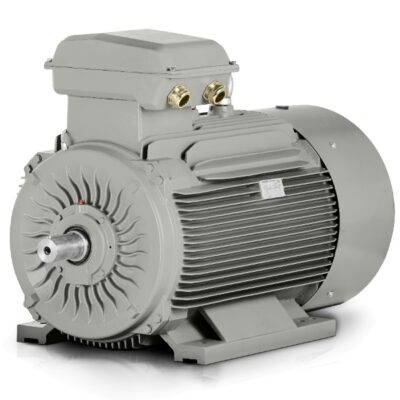
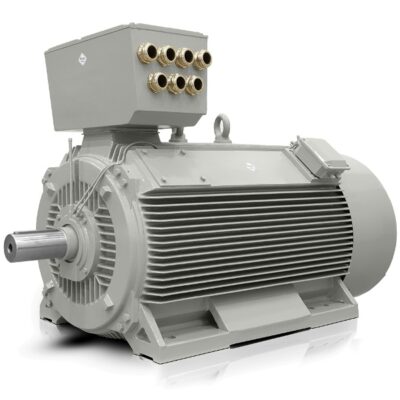
Three-phase electric motor: H17R-315-4 220KW 6000V 50HZ
| Basic technical data | |
| Motor type | H17R 315-4 |
| Rated power (kW) | 220 |
| Frame size (mm) | 315 |
| Number of poles | 4 |
| Rated speed (rpm) | 1480 |
| Frequency (Hz) | 50 |
| Electrical parameters | |
| Rated voltage (V) | 6 000 |
| Connection | Y |
| Rated current (A) | 25,5 |
| Efficiency at 100% load (%) | 94,8 |
| Power factor at 100% load | 0,88 |
| Starting and torque characteristics | |
| Rated torque (Nm) | 1420 |
| Locked-rotor torque ratio (LRT/RLT) | 0,74 |
| Breakdown torque ratio (BDT/RLT) | 2,2 |
| Locked-rotor current ratio (LRA/RLA) | 5,2 |
| Rotor moment of inertia (kg·m²) | 4,2 |
| Accessories | |
| 6 x PT100 in winding | |
| 1 x PT100 in NDE bearing | |
| 1 x PT100 in DE bearing | |
| Anti-condensation heater 230 V | |
| 3 x PTC thermistor | |
| Applicable standards | |
| Specification | IEC60034-1 |
| Testing | IEC60034-2 |
| Noise | IEC60034-9 |
| Vibration | IEC60034-14 |
| Construction and operating data | |
| Mounting arrangement | IM B3 (other designs on request) |
| Duty type | S1 |
| Load type | Parabolic or linear curve |
| Degree of protection | IP55 |
| Insulation class | F |
| Temperature rise class | B |
| Cooling method | IC411 |
| Starting method | DOL, VFD, Soft-starter |
| Direction of rotation | Both |
| Vibration (mm/s) | 2.8 |
| Rotor cage | copper bar |
| Terminal box type | VYBO CB1-HV |
| Operating conditions | |
| Ambient temperature range (°C) | -20 to +40 (-30, +50, +60 optional) |
| Maximum installation altitude | up to 1000 m |
| Weight and surface finish | |
| Approximate weight | 2900 kg |
| Colour | RAL7030 |
| Paint finish | shiny |
| Bearings and lubrication | |
| DE/NDE bearings | 6322-C3/6322-C3 |
| Lubricant | Li based, no.2 class |
Compact output in the higher-voltage class is delivered by model H17R-315-C-4-6 with an output of 220 kW for operations that need stable pulling force and controlled starting under long-term load. This 1400 rpm electric motor is designed to perform well in technological systems where operating continuity, precise connection to the transmission system and predictable behaviour at the operating point are decisive.
1400 rpm electric motor for industrial drives with reserve
In the H17R Compact PRO-HV configuration, the three-phase electric motor operates so that it maintains balanced running under demanding use at rated speed. The rotor cage made of copper strip reduces rotor losses while supporting thermal resistance during long operating cycles, which is particularly beneficial under frequent load and process fluctuations.
- Copper rotor for long service life improves behaviour under continuous load and limits energy losses that would otherwise be converted into heat.
- IE4 Super Premium efficiency helps reduce operating costs in drives that run in multi-shift production.
- Voltage selection simplifies integration into existing networks and expands use in projects with different voltage standards.
- A shaft height of 315 mm creates a suitable basis for robust mounting in machines with higher torque requirements.
Efficiency and torque for heavy technological systems
When designing a drive, not only power reserve but also behaviour under changing load is important. The 4-pole electric motor in this class provides a balanced compromise between speed and torque, which is appreciated by designers of pumping stations, compressor units and conveyor systems with irregular cycles.
- Rated torque of 1420 Nm supports smooth starting of heavier units.
- A power factor of 0,88 helps when designing the power supply and sizing switchboards.
- Rated current of 25,5 A makes it easier to monitor operating conditions in the electrical section of the line.
- Rotor moment of inertia of 4,2 kg·m² helps stabilise operation in applications with dynamic load changes.
Design suitable for demanding deployment
Service predictability is also important for a high-voltage electric motor. DE bearing 6322-C3 and NDE bearing 6322-C3 support reliable rotor mounting over long service intervals, while a weight of 2900 kg corresponds to a robust frame for industrial machines and technological assemblies.
- Insulation class F increases winding resistance under thermal load.
- Temperature rise B helps keep operation within limits suitable for long cycles.
- High starting current requires proper adjustment of the power-supply system, which is a standard design step with HV electric motors.
Voltage adapted to the existing network
In production where the technology is already adapted to the distribution system, voltage selection without unnecessary intervention in the infrastructure is important. This H17R Compact PRO-HV series supports multiple voltage levels, allowing it to be integrated into new projects and reconstructions with different network concepts.
Such a solution performs well in mixing lines, mining conveyors, pressing machines, aggregate crushers, milling systems, incinerator fans, process-air compressors, cooling-water pumps, desulphurisation pumps, rolling lines, steel-strip winders, concrete mixers, polymer extruders and process-material dryers.
Operating support and temperature monitoring
For motors intended for continuous operation, it makes sense to monitor thermal behaviour directly in the winding and bearing points. The design of this model allows the use of elements that simplify service diagnostics and help prevent unplanned shutdowns at critical line nodes.
- 6 x PT100 in the winding supports more precise temperature-state monitoring during long-term load.
- 1 x PT100 in the NDE bearing helps monitor the mounting condition on the non-drive side.
- 1 x PT100 in the DE bearing provides additional monitoring of the drive side.
- An anti-condensation heater limits the risk of moisture when the machine is stopped.
- 3 x PTC thermistors supplement winding protection under thermal stress.
VYBO Electric is the largest company in its sector in Central Europe and builds its portfolio around solutions that perform in project practice and long-term service. Take advantage of the offer and choose a motor whose copper rotor, efficiency and voltage flexibility help keep the technology running with lower losses and stable reserve for demanding operation.